
What Is an ELCI and Why Do I Need One?
Equipment Leakage Circuit Interrupters Explained
Wednesday, October 21, 2026
Estimated read time: 13 Minutes

Your main breaker counts how much current flows. An ELCI asks whether all of it came back.
Who Should Read This?
Boat owners who plug into shore power, boatbuilders and refit yards, marine electricians and ABYC-certified technicians, marine surveyors, and the marina operators who now measure what every boat leaks. If you specify, install, inspect, or simply live with an AC shore power system, this one device decides whether a small leak ends as a tripped breaker or as current in the water. It touches safety, ABYC E-11 compliance, survey and insurance outcomes, and liability.
The Boat That Went Quiet
It’s Friday evening, and you’re walking down the dock with a cooler and a plan: bait at 6:00 AM, lines out by 7:30 AM. You step aboard and stop. The cabin is stuffy, the fridge is silent, and everything in it is warm. Your neighbor’s boat is humming along. Yours is quiet.
You open the panel and find the ELCI main breaker tripped. You reset it. It holds. Ten minutes later, click. So you do what any good skipper does: switch off every branch breaker, reset the ELCI, and bring the circuits back one at a time. Everything holds until the water heater. The tank is cold, so the element comes on the moment the breaker closes. A few minutes later, click.
Your Saturday didn’t die tonight. It died Wednesday afternoon, when the heater cycled on, and the ELCI shut the boat down. That’s the cost of this kind of protection: when the ELCI trips, it disconnects shore power, and the fridge loses power with it. But the ELCI didn’t fail you. It told you something no other breaker on the boat can: current was leaving your boat by a path it shouldn’t take.
Isolating a repeat trip breaker by breaker is a fair diagnosis. A qualified marine electrician should do the repair.
So where did that current go, why couldn’t anything else on the boat see it, and why does a number as small as 30 milliamps decide between a warm fridge and something far worse? Let’s walk through it.
Where Did the Leak Go?
Leakage current has a few favorite hiding spots. The classic is the water heater: its element sits inside a thin metal sheath, heat cycles crack the insulation, and a few milliamps slip into the tank. Battery chargers are another repeat offender, since an aging charger can let a trickle of AC bleed to its chassis. And moisture inside a shore cord connector builds a conductive path no wiring diagram ever showed. Keep that last one in mind: the cord and the inlet sit ahead of your ELCI, so they are the dock’s protection to catch, not yours.
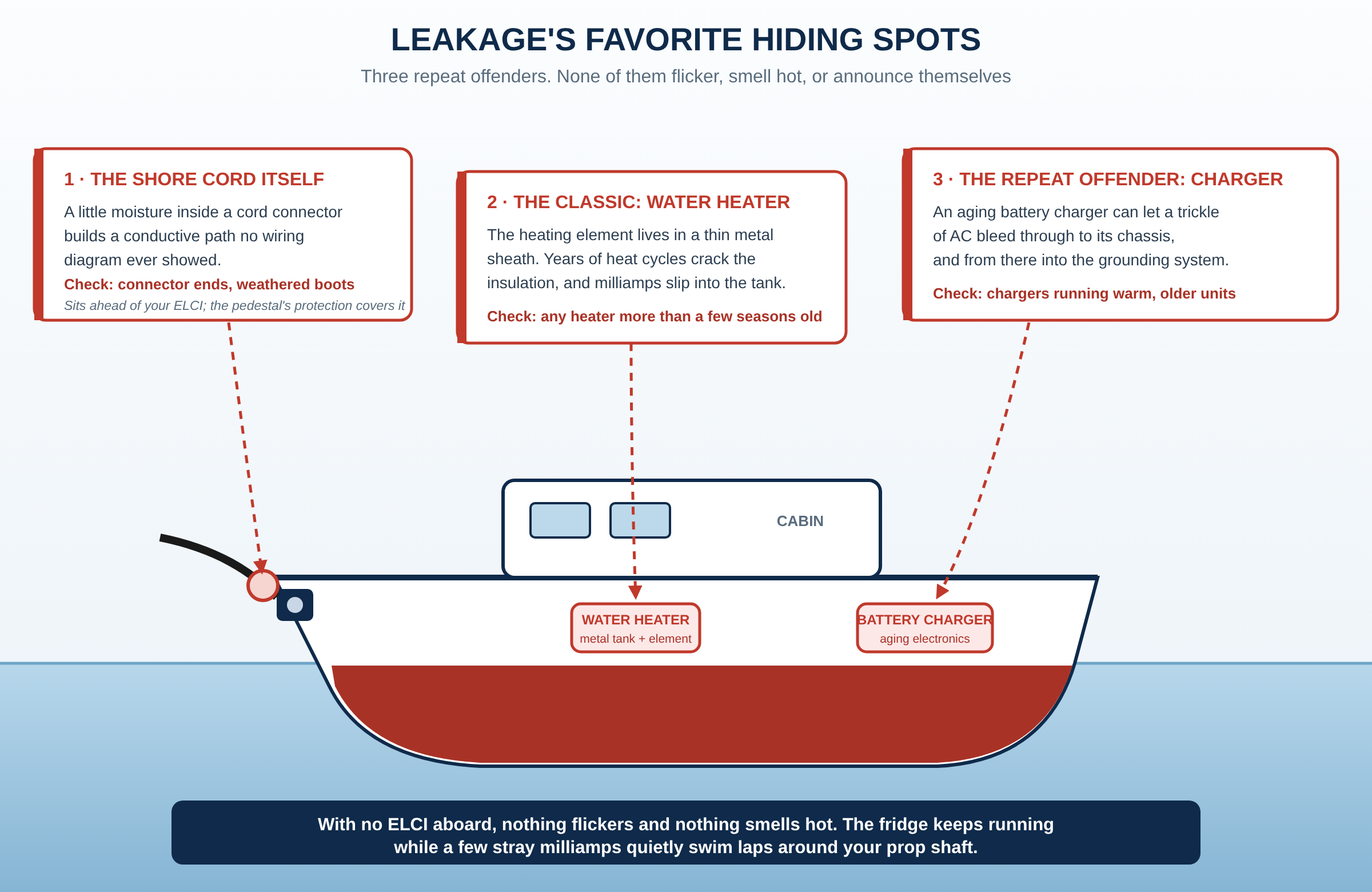
Figure 1. Leakage’s favorite hiding spots: the shore cord, the water heater element, and an aging battery charger. None of them announce themselves.
Wherever the leak starts, the current lands on the green grounding wire, doing exactly what it is supposed to do: carrying fault current back toward its source. On a boat with no ELCI, nothing flickers and nothing smells hot while a few stray milliamps look for a way home.
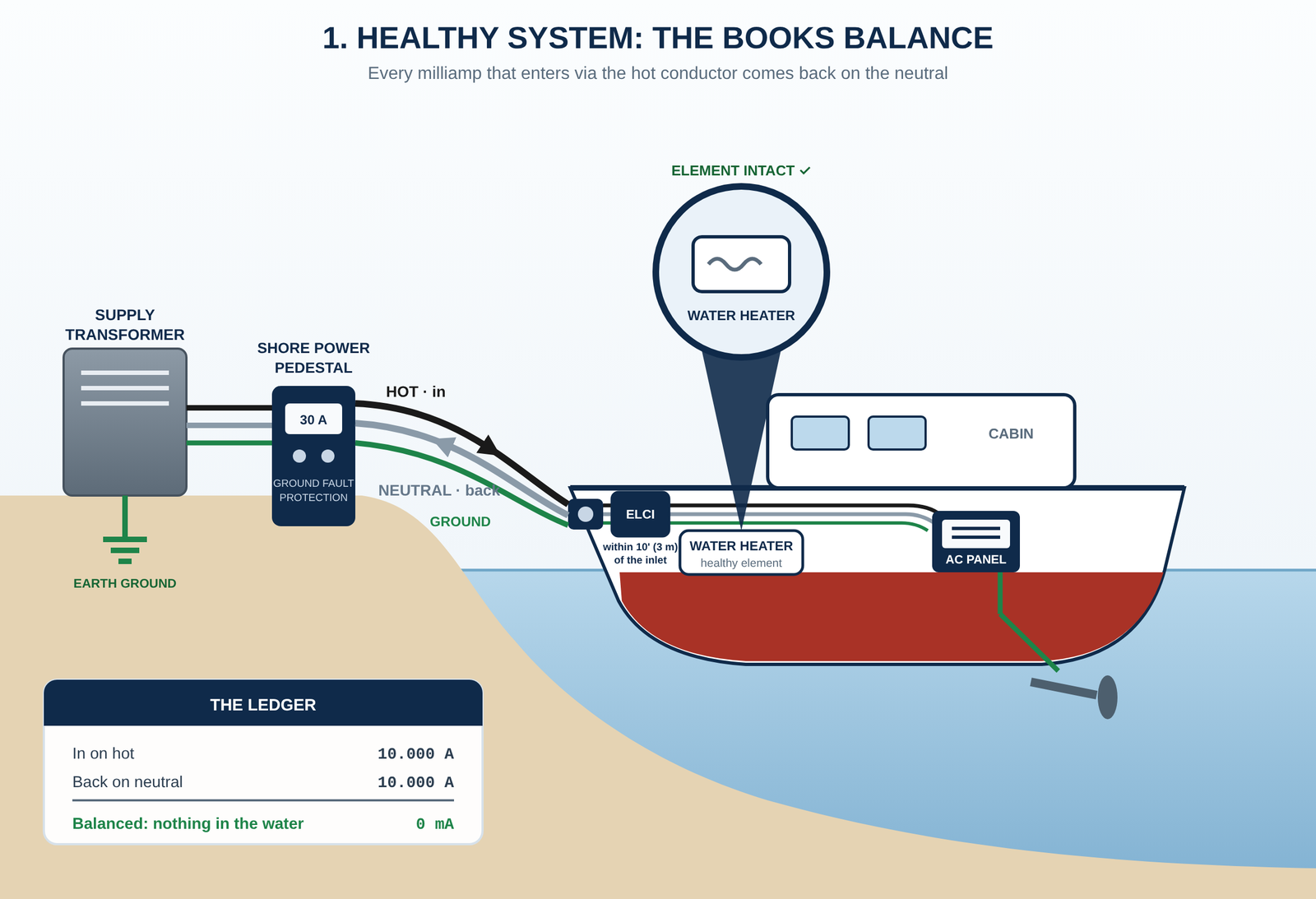
Figure 2. A healthy system. Every milliamp that enters via the hot comes back on the neutral, and the books balance.
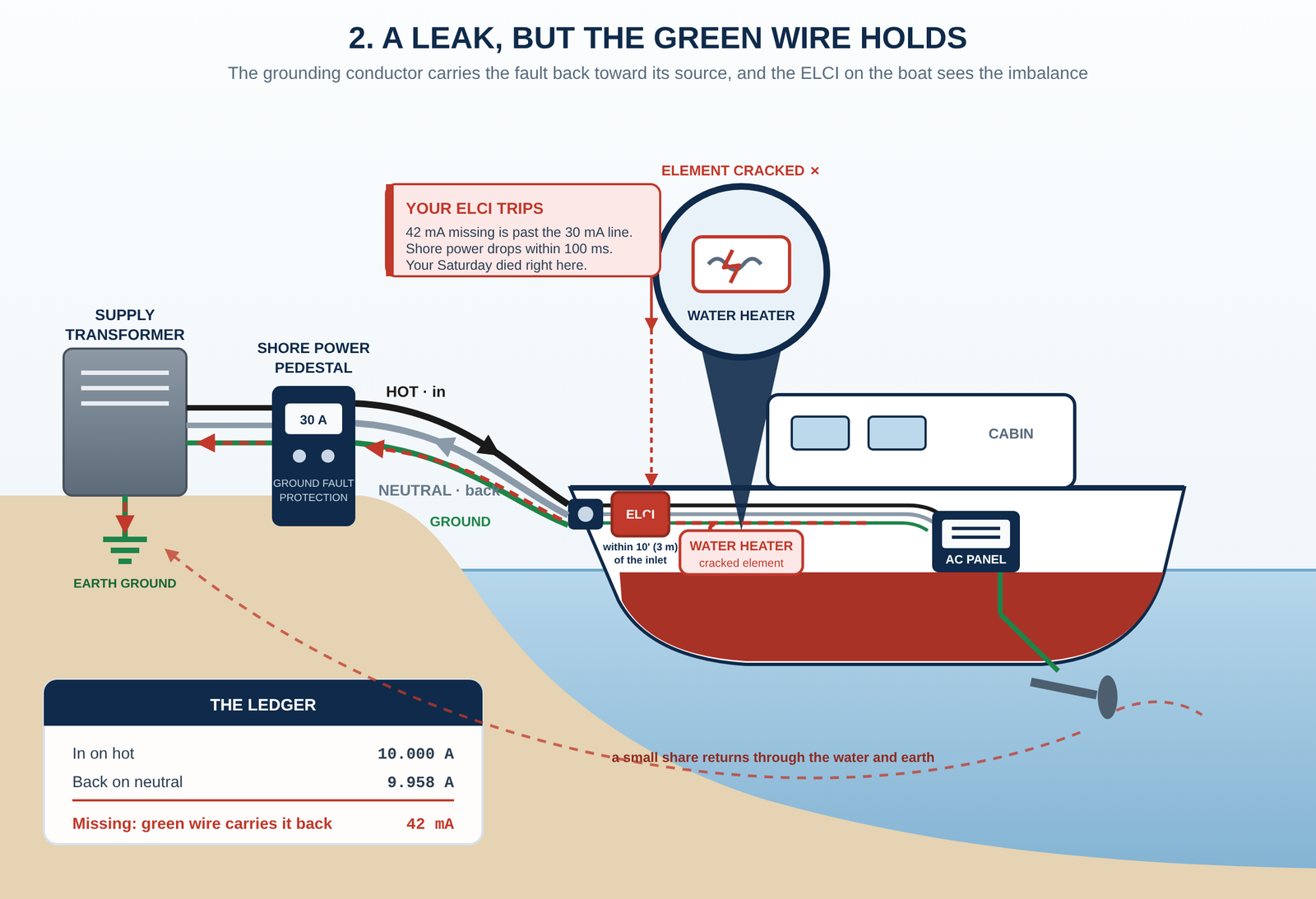
Figure 3. A cracked element leaks current. The green wire carries most of it home, and the ELCI on the boat sees the imbalance and trips.
Why Your Breaker Never Noticed
Hold on. You have a 30A main breaker on that shore power circuit. Isn’t catching problems its whole job? Let’s run the numbers. A 30A breaker is built to carry 30,000 milliamps all day. A serious leak might run 100 milliamps. To your main breaker, that leak sits a factor of 300 below anything it was designed to react to. That’s like asking a truck scale to notice a missing lug nut.

Figure 4. A 30A breaker is built to carry 30,000 milliamps. A 100 mA leak, drawn to the same scale, is the red sliver.
Your breaker isn’t broken. Overcurrent protection watches for overloads and short circuits, and it does that job well. It counts how much current flows; it never asks whether all of it came back. That’s the gap the ELCI was built to close.
Meet the Accountant: What an ELCI Actually Does
An ELCI (equipment leakage circuit interrupter) lives on your boat, at the shore power end of the AC system. It does one continuous piece of accounting: it compares the current coming in on the hot conductor with the current returning on the neutral.
Say your boat is pulling 30A. If 30.00A goes in on the hot and 29.97A comes back on the neutral, then 0.03A, which is 30 mA, went somewhere else. That’s the line. Within 100 milliseconds the ELCI opens the circuit, hot and neutral both. Mind the decimal point: if only 29.7A came back, you’d be missing 300 mA, ten times the trip point.
That’s the line. Within 100 milliseconds, the boat is off shore power.
Every milliamp that enters via the hot has to come back on the neutral. An ELCI is the accountant standing at your boat’s shore power inlet, and if the books are off by more than 30 mA, it shuts the business down in a tenth of a second.
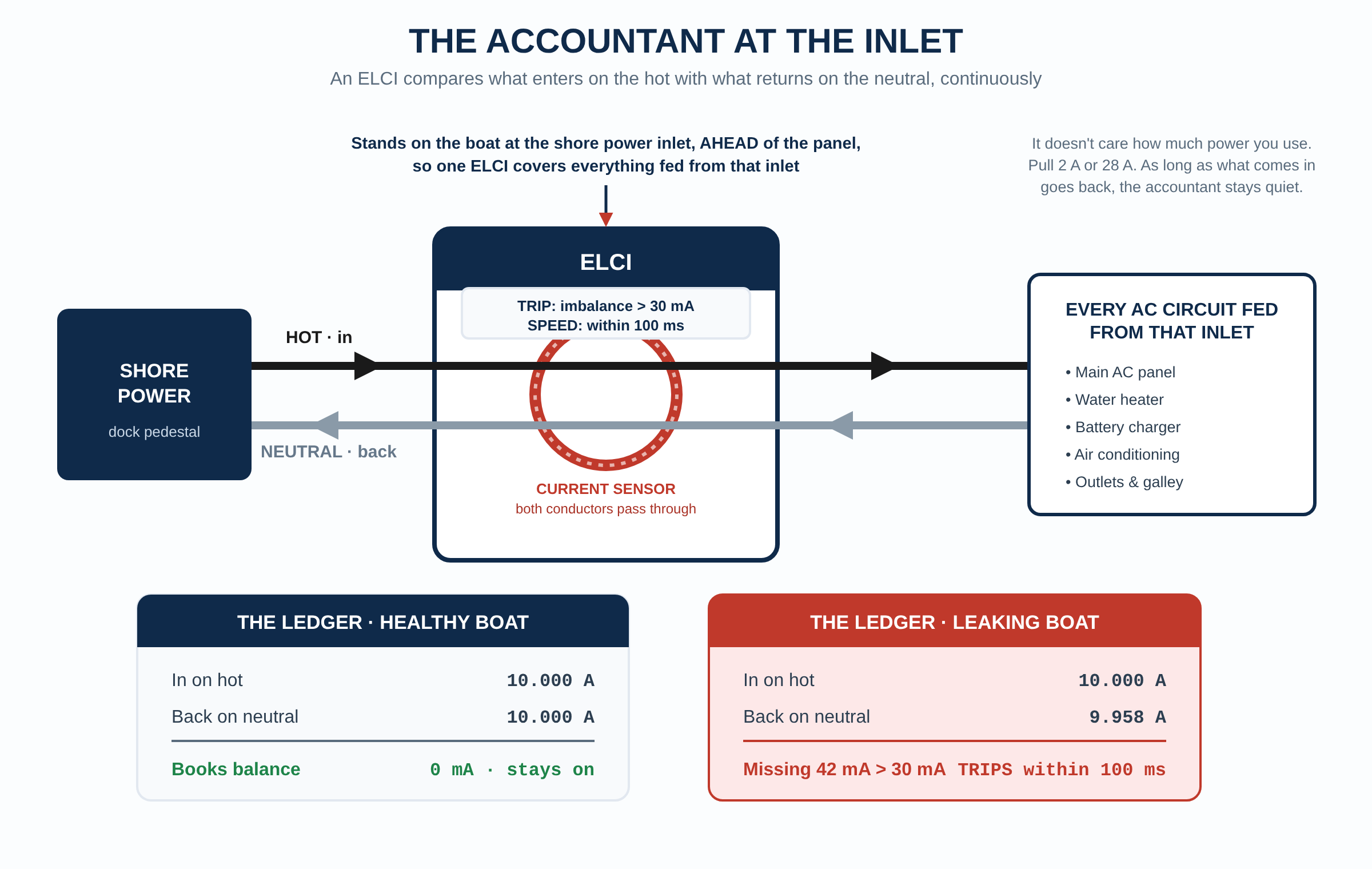
Figure 5. The ELCI compares current in on the hot with current back on the neutral. Off by more than 30 mA, and it disconnects the boat within 100 milliseconds.
How does it count? Hot and neutral both pass through a current transformer, a sensing ring. When the two currents match, their magnetic fields cancel and the ring sees nothing. An imbalance leaves a net field, and that is the trip signal. The green grounding wire deliberately stays outside the ring: it is the path fault current takes home, so it has to stay out of the comparison. On a 120/240V system, both hots and the neutral go through the ring.
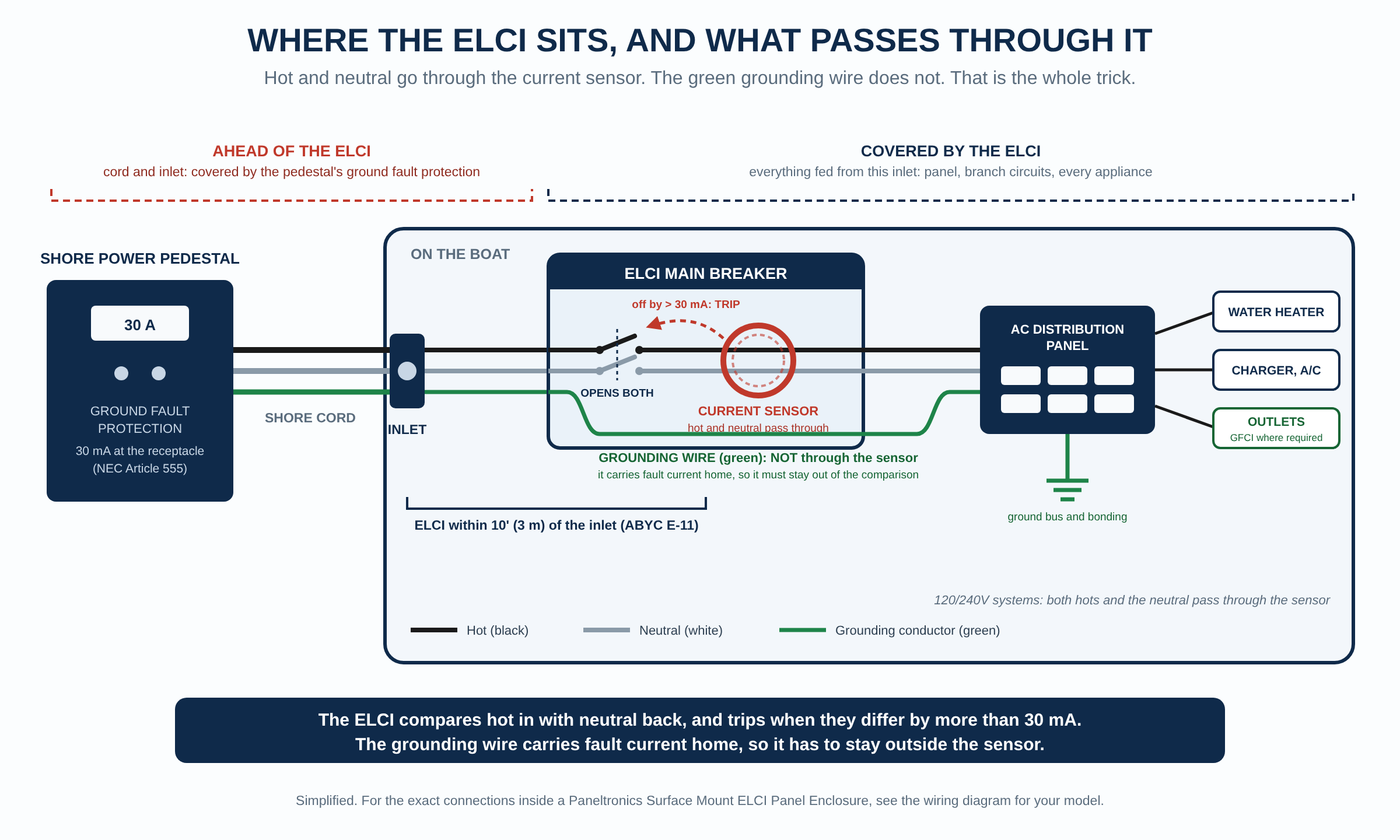
Figure 6. Where the ELCI sits and what passes through it. Hot and neutral go through the sensor; the grounding wire does not.
Notice what the ELCI is not doing. It doesn’t care how much power you’re using. Pull 2A or 28A, and the accountant stays quiet, as long as what goes in comes back. Because it stands ahead of the panel, one ELCI covers everything fed from that inlet (two inlets, two ELCIs). The cord and inlet ahead of it are the one stretch it can’t see, which is why the dock carries protection of its own, and why ABYC wants the ELCI close to the inlet.
Why 30 Milliamps Is the Line
Back to the dock. Your ELCI cost you a cooler of groceries. Now run the same story with no ELCI aboard.
The same cracked element leaks the same milliamps, and a healthy green wire carries nearly all of it back toward shore. But it takes two faults to put current in the water, and the second one is quiet: a grounding path that has corroded, loosened, or was never wired right. Now the water becomes the way home. Current flowing through the water sets up an electrical field, strongest near the hull and fading with distance, and a swimmer in that field becomes part of the circuit. Fresh water conducts poorly, so the current looks for a better path, and the human body is that better path.
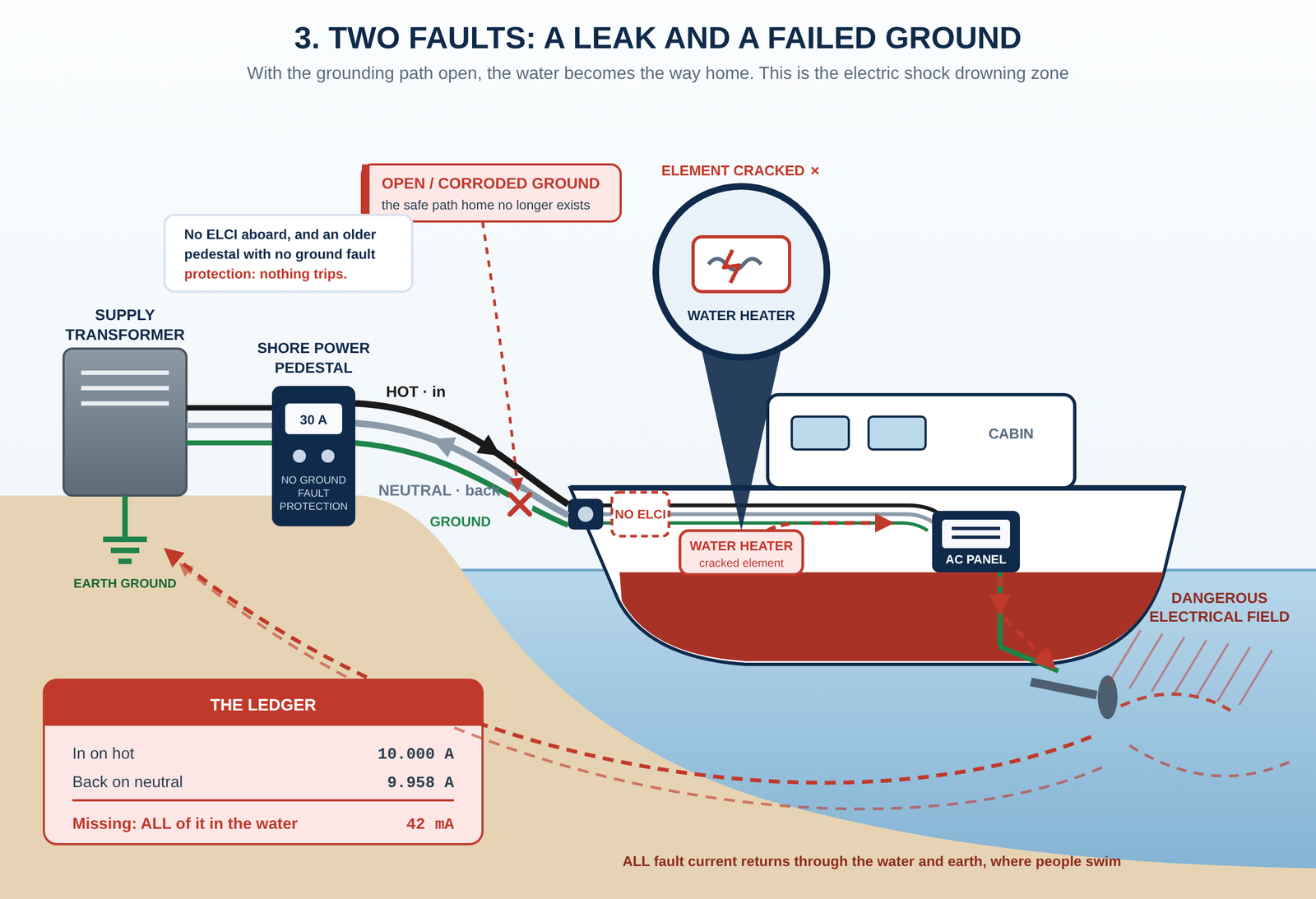
Figure 7. Two faults on a boat with no ELCI: the same leak plus a corroded ground. The water becomes the return path, and the field around the hull is where swimmers get hurt.
The physiology is unforgiving. NASBLA, the association of state boating-law administrators, puts it at as little as 10 to 20 milliamps through the body to seize a swimmer’s muscles while leaving them fully conscious. They can’t swim, can’t grab a ladder, and often can’t call out. The boating-safety world calls it electric shock drowning (ESD), and most cases happen at marinas and docks.
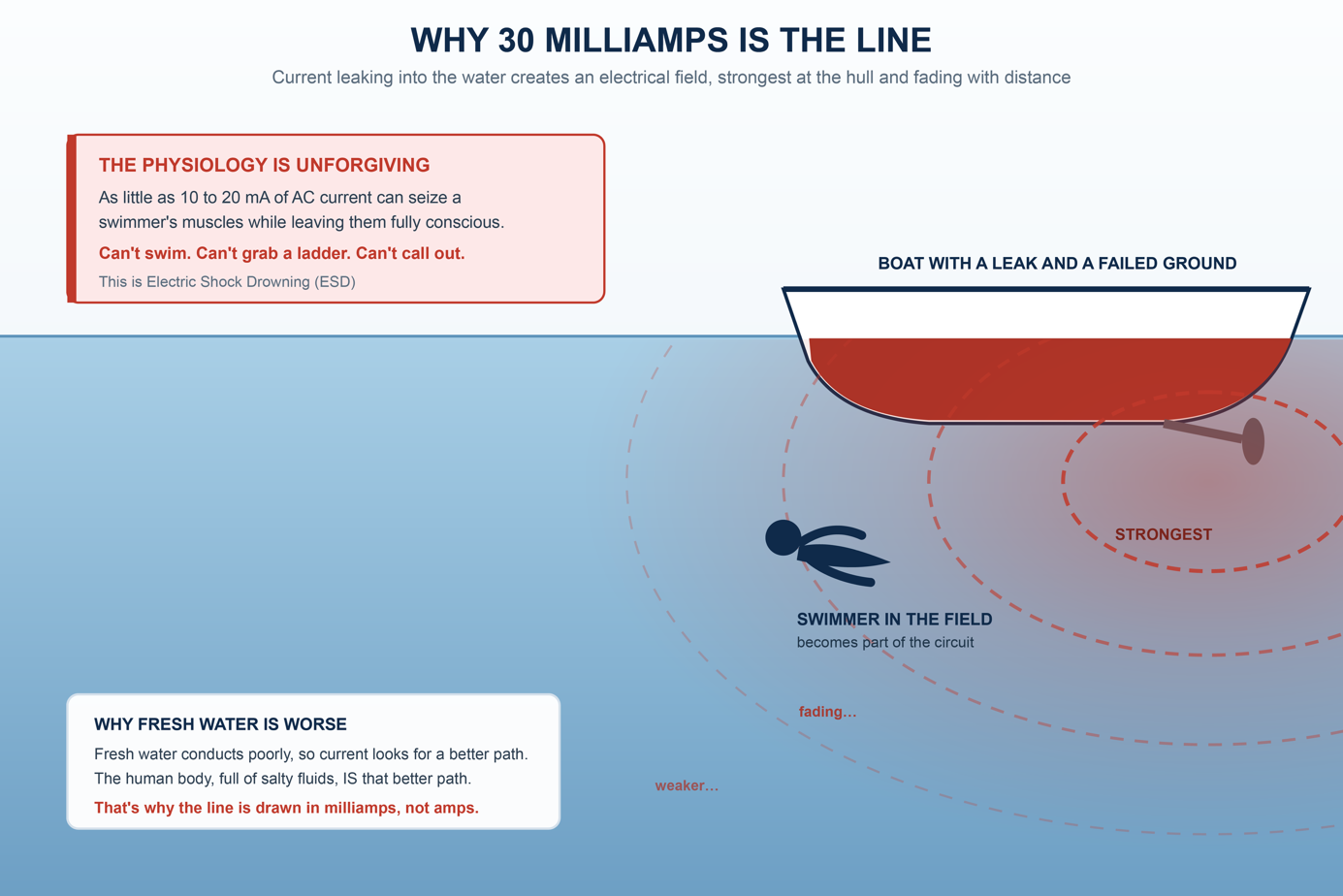
Figure 8. Current in the water forms a field that is strongest at the hull and fades with distance. As little as 10 to 20 milliamps of AC can seize a swimmer’s muscles.
So why draw the line at 30 mA and not lower? Because a healthy boat already leaks a few milliamps by design, spread across every appliance with a heating element or a filter. Set the line much lower and the boat trips with nothing wrong; ABYC’s own note warns that lower settings “may result in nuisance trips in certain environments.” Thirty milliamps is the residual-current level much of the world uses for personal shock protection: high enough to live with, low enough to matter.
The trip you resented on Wednesday is the same fault that would have gone looking for a swimmer in August.
What ABYC E-11 Says, and Who’s Watching
ABYC E-11, section E-11.11.1, spells it out:
- What: an ELCI, or a Type A residual current device, on each shore power inlet. The one alternative is an isolation transformer installed within 10’ (3 m) of the inlet.
- Where: with or in addition to the main shore power disconnect breaker, or at the extra overcurrent protection within 10’ (3 m) of the inlet, whichever is closer to the shore power connection. And readily accessible, because a protective device you can’t reach never gets tested.
- How it trips: at 30 mA, within 100 milliseconds.
- Since when: the 2008 edition, with a compliance date of July 31, 2010 for new shore power installations.
Four acronyms, one idea. All of these compare current coming in with current going back, and trip on the difference.
- GFCI, ground fault circuit interrupter: the 5 mA version at an outlet.
- ELCI, equipment leakage circuit interrupter: the 30 mA version at the shore power inlet.
- RCD, residual current device: the international name for the same device, at any rating.
- RCBO: an RCD with an overcurrent breaker built into the same body. One device, two jobs.
ABYC standards are voluntary, and they speak to new construction. Nobody is coming to retrofit a 2005 boat. But older boats don’t get left alone in practice. Marine surveyors inspect against today’s ABYC and write up a missing ELCI, and insurers read those recommendations. The dock side has moved too: NEC Article 555.35 now requires ground-fault (GFPE) protection in the marina, 30 mA or less at each shore power receptacle and 100 mA or less on the feeders behind them, plus a leakage-measuring device so the marina can check how much your boat leaks. A leaky boat can be told to fix it or leave. The NEC covers the marina, not your boat. The boat is on you.
Our engineering manager, Jose Verdecia, sits on an ABYC Project Technical Committee, so we watch this language evolve line by line. For the text itself, see our ABYC E-11 excerpts.
ELCI vs. GFCI: Layers, Not Rivals
Short answer: a GFCI protects a person at one outlet; an ELCI protects the whole AC system fed from the inlet, including the hard-wired appliances a GFCI never sees. Both devices do the same accounting. They differ in where they stand and how strict they are.
| GFCI | ELCI | |
|---|---|---|
| Trip threshold | 5 mA (Class A) | 30 mA |
| Where it lives | At the outlet: galley, head, machinery space, weather deck | On the boat, at the shore power inlet end |
| Coverage | One outlet or branch circuit | Everything fed from that inlet |
| Who it protects | The person using that outlet | Everyone aboard, and swimmers nearby |
ABYC wants both. Layers, not rivals.
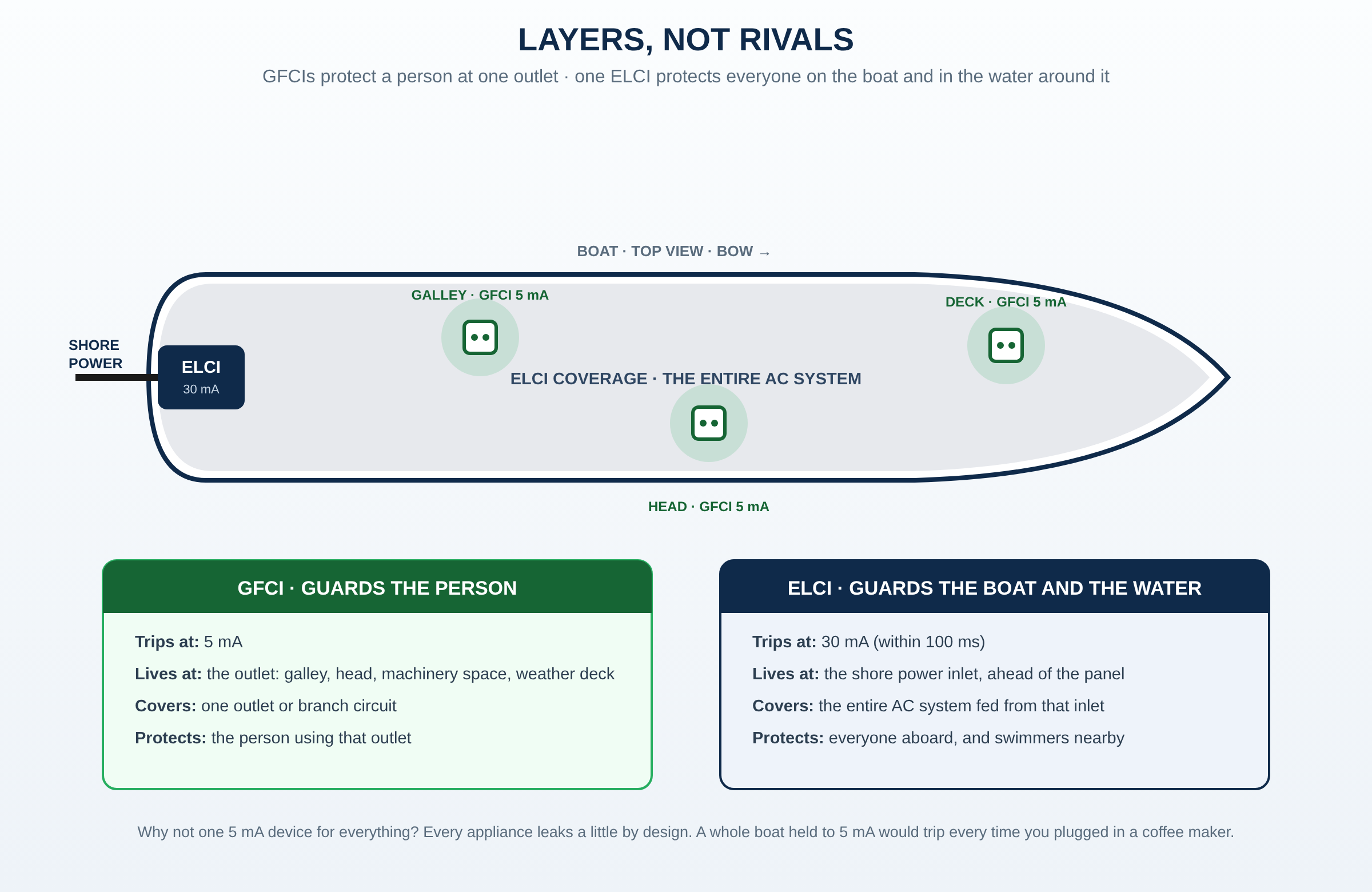
Figure 9. GFCIs protect the person at an outlet at 5 mA; one ELCI at the inlet protects the whole AC system at 30 mA.
Putting the ELCI Where It Belongs
We published ELCI compliance guidance in 2010, as the E-11 compliance date arrived, with three ways to build the protection into a marine circuit breaker panel. All three are still in our technical library.
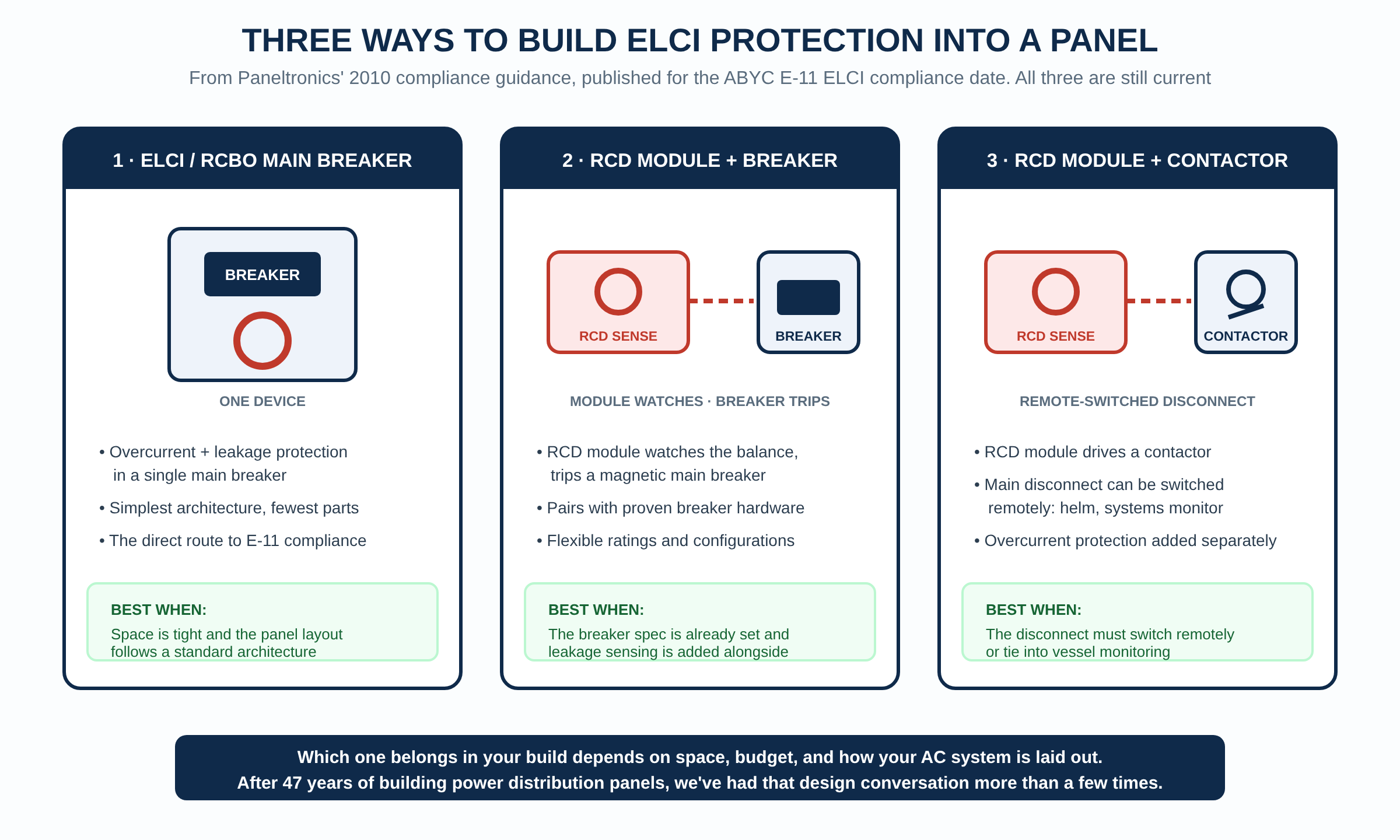
Figure 10. Three ways to build ELCI protection into a marine electrical panel: an ELCI/RCBO main breaker, an RCD module paired with a breaker, or an RCD module driving a contactor.
You don’t have to engineer it yourself. Our Surface Mount ELCI Panel Enclosures put an ELCI main circuit breaker, with shore-power overcurrent and equipment-leakage protection, in an IP66-rated polycarbonate enclosure designed to comply with ABYC E-11 when installed within 10’ (3 m) of the shore power inlet. Pick the one that matches your shore power:
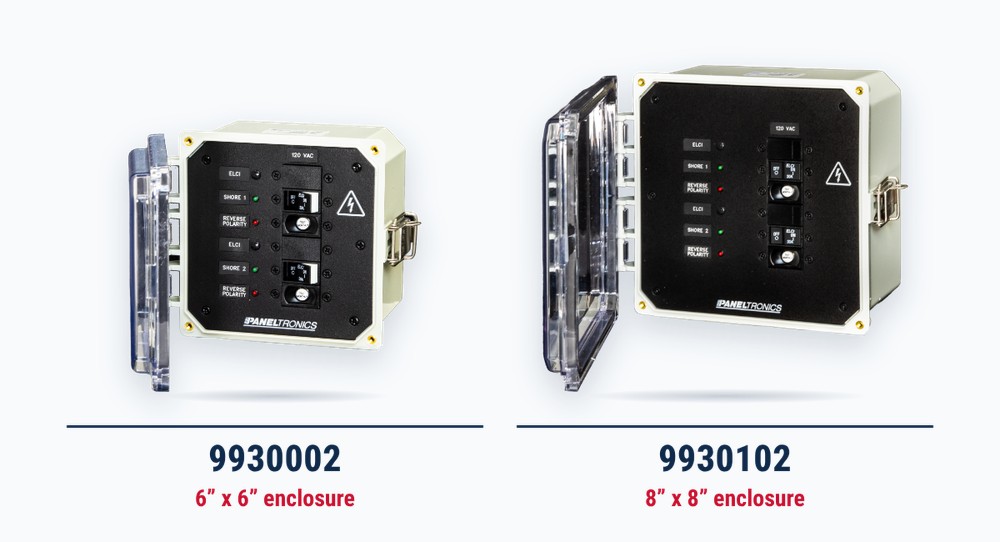
30A Shore Power
Part Numbers 9930002 and 9930102
- Dual 120VAC / 60Hz / 30A ELCI Mains
- Two Shore Power Inputs
- 6” x 6” enclosure (9930002) or 8” x 8” enclosure (9930102)
50A Shore Power
Part Numbers 9930004 and 9930104
- 120/240VAC / 60Hz / 50A ELCI Main
- 1 Blank Circuit Breaker Position
- 6” x 6” enclosure (9930004) or 8” x 8” enclosure (9930104)
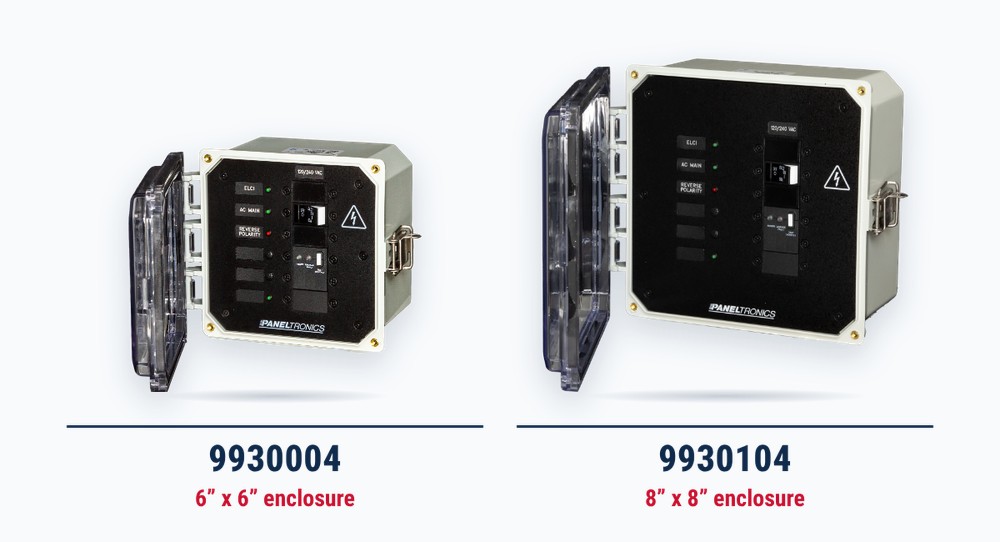
Each pair is electrically identical. Only the enclosure size differs.
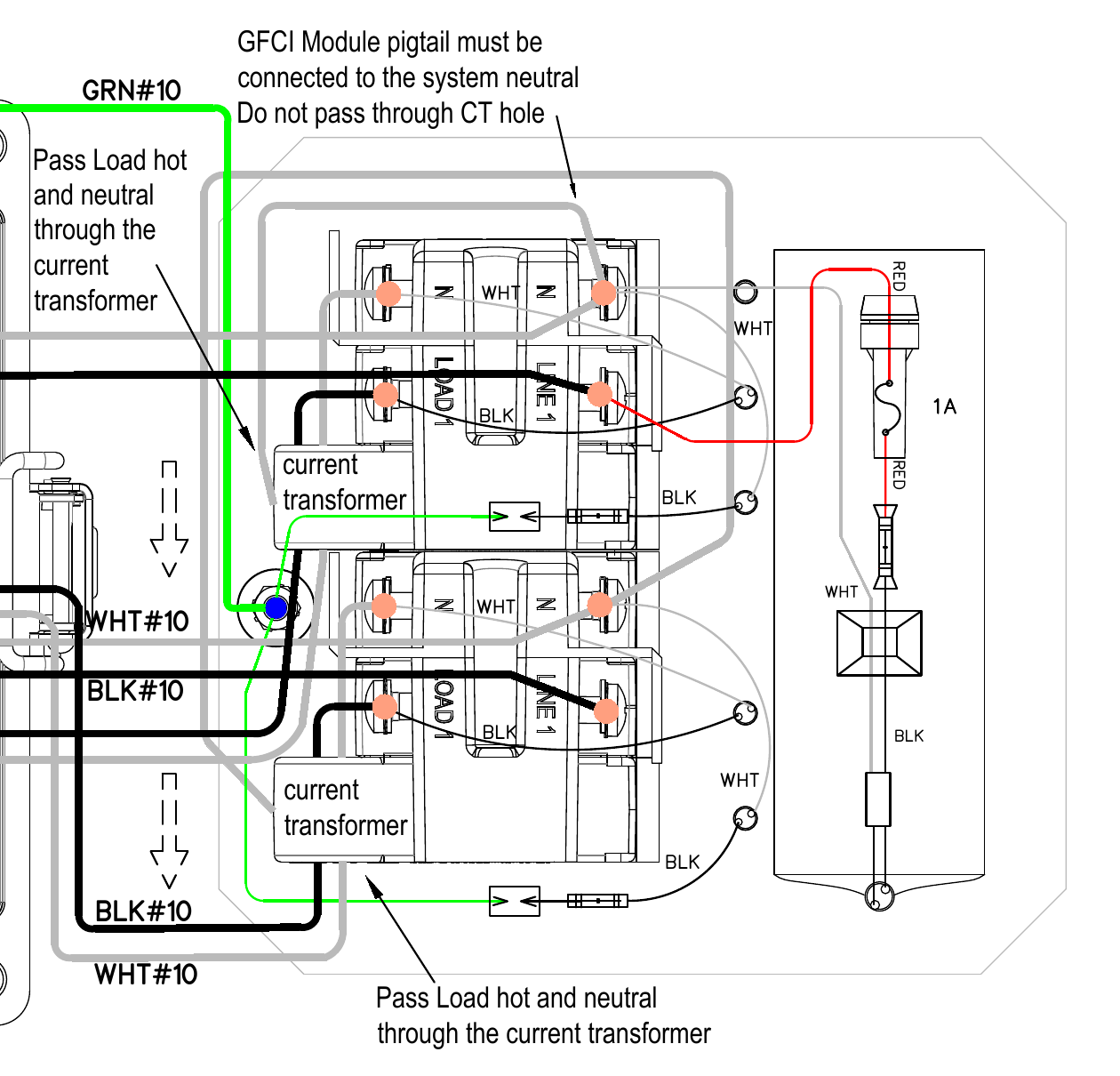
Figure 11. Detail from the 9930002 wiring diagram: two 30A ELCI main breakers, each with its own current transformer. Hot and neutral pass through it; the grounding conductor does not.
Now You Know
Your shore power breaker guards against overloads, but it can’t see small leaks. An ELCI on your boat watches the balance between hot and neutral, and it disconnects the boat within a tenth of a second if more than 30 mA goes missing. That protects your wiring and the people in the water around your hull. ABYC E-11 has called for it on new shore power installations since 2010, and surveyors, insurers, and marinas are steadily expecting it on older boats too. The next time an ELCI trips on you, you’ll know it isn’t nagging. It’s accounting.
So the next time the ELCI takes the boat down, remember what it just told you:
Not nagging. Not a defect. Accounting.
Don’t Wait for the Wednesday Trip, or the August Swimmer
If your boat has shore power and no ELCI, or you’re building or refitting a panel, get one in before the season. Every Surface Mount ELCI Panel Enclosure we ship is built and reviewed by the same engineering team behind this article.
- Request a quote. Email sales@paneltronics.com, subject “ELCI Panel Quote.” Tell us 30A or 50A, one inlet or two.
- Talk to an engineer. Call 305-823-9777. Send a one-line diagram and we’ll review the ELCI placement with you.
- Get the paperwork. Data sheets and wiring diagrams for all four models are available on request; the lineup is on the product page.
Request a quote for your next build at paneltronics.com, email sales@paneltronics.com, or call 305-823-9777. Factory-trained technical support is part of every quote, not an upsell.
About the Author

|
Edwin (Ed) Robledo, Paneltronics Senior Technical Marketing. 10+ years of published content creation and technical writing in the electrical and electronics industry, including articles and white papers on circuit, electrical design, and engineering best practices. |
In Collaboration with:
Jose Verdecia, Paneltronics Engineering Manager and ABYC Project Technical Committee Member
Frequently Asked Questions
Q1. What is an ELCI on a boat?
An ELCI (equipment leakage circuit interrupter) is a whole-boat ground fault device installed on the boat near the shore power inlet. It compares the current entering on the hot conductor with the current returning on the neutral and disconnects shore power within 100 milliseconds if the difference exceeds 30 mA.
Q2. What is the difference between an ELCI and a GFCI?
Both trip on a current imbalance. A GFCI trips at 5 mA and protects a person at one outlet. An ELCI trips at 30 mA at the shore power inlet and protects the entire AC system fed from that inlet, including hard-wired appliances a GFCI never sees. ABYC E-11 calls for both.
Q3. Does ABYC require an ELCI?
ABYC E-11 (section E-11.11.1) calls for an ELCI, or a Type A residual current device, on each shore power inlet, installed with or near the main shore power disconnect and within 10’ (3 m) of the inlet. The requirement entered the 2008 edition with a compliance date of July 31, 2010. An isolation transformer within 10’ (3 m) of the inlet is the accepted alternative.
Q4. Why does my ELCI keep tripping?
A trip means more than 30 mA is returning by a path other than the neutral. Common causes are inverters, a neutral-to-ground connection aboard while on shore power, a failing water heater element or charger, and several small leaks adding up. Find and repair the leak; never defeat the ELCI.
Q5. Why is the ELCI threshold 30 mA?
A healthy boat leaks a few milliamps by design, so a lower setting would trip with nothing wrong; ABYC notes that lower settings may cause nuisance trips. 30 mA is the level used worldwide for personal shock protection.
Q6. Can I add an ELCI to an older boat?
Yes. You can add an ELCI between the shore power inlet and the existing main breaker, provided the boat has no existing leakage faults. Surface-mount ELCI panel enclosures, such as Paneltronics’ 30A and 50A models, are built for this installation.
Disclaimer. This article is provided for general educational and informational purposes only. It reflects Paneltronics’ understanding and interpretation of ABYC E-11, NEC Article 555, and related publications as of October 2026. It is not a substitute for the standards themselves, which are available from their publishers, and it is not engineering, legal, or installation advice. Standards and codes change, and their application depends on the vessel, the installation, and the authority having jurisdiction. The American Boat & Yacht Council and the National Fire Protection Association have not reviewed, approved, or endorsed this article, and no affiliation is implied. Shore power and ground fault protection equipment should be selected and installed by a qualified marine electrician in accordance with the manufacturer’s instructions and all applicable standards and regulations. Paneltronics makes no representation or warranty as to the accuracy or completeness of this information and, to the fullest extent permitted by law, disclaims all liability for errors or omissions and for any loss, injury, or damage arising from its use. Product specifications are subject to change without notice; refer to the current data sheet and installation instructions.

